A Hawaiʻi 501(c)(3) Nonprofit
So our keiki can thrive here for generations.
Bridging Hawaiʻi’s keiki into skilled-trades apprenticeships — so staying home is a choice, not a luxury.
A Hawaiʻi 501(c)(3) Nonprofit
Bridging Hawaiʻi’s keiki into skilled-trades apprenticeships — so staying home is a choice, not a luxury.
Hawaiʻi already has world-class apprenticeship programs — IBEW Local 1186, Plumbers & Fitters 675, the Hawaiʻi Carpenters Apprenticeship & Training Fund, Laborers 368, ABC Hawaiʻi. These are paid, multi-year pathways into journey-level careers that pay enough to raise a family on these islands.
The problem isn’t training. The problem is the door. Hawaiian keiki — especially on Hawaiʻi Island, Waiʻanae, Kaʻū, and Molokaʻi — don’t know the intake windows, can’t always get to Honolulu for testing, can’t afford the boots and the drug-test fee, and don’t have anyone in their corner once they start. So they apply somewhere else. Or they don’t apply at all. Or they wash out in the first three months.
Hana Lima Youth Foundation is the bridge. We find Hawaiian high schoolers who could thrive in the trades, prepare them for apprenticeship intake, place them with our partner programs, and stand with them through year one. Staying home, building careers, on our ʻāina.
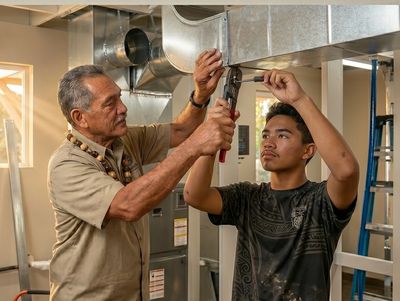
We identify Hawaiian high schoolers — especially on Hawaiʻi Island — who could thrive in the trades but aren’t on anyone’s recruitment list. Partnering with schools, families, and community.
Application coaching. Drug-test fees. Boots, tools, transport. Math refreshers. The family conversations. The hundred small things between thinking about applying and actually applying.
We deliver prepared candidates into the intake windows of our partner programs — IBEW Local 1186, Plumbers & Fitters 675, HCATF, ABC Hawaiʻi, Laborers 368, and others as partnerships grow.
Wraparound stipend and mentor through the first ninety days of apprenticeship — the dropout cliff. The trades don’t lose people because the work is too hard. They lose people because life gets too hard.
Hawaiʻi has the highest cost of living of any U.S. state
In 2010, 55% of Native Hawaiians still called the islands home. By the 2020 U.S. Census, just 47% did. More of us now live on the continent than at home.
— of skilled-trades workers needed across the islands in the coming decade.
HLYF is a Hawaiʻi 501(c)(3) nonprofit corporation. Our articles of incorporation are filed. Our IRS determination letter is in hand. Our bylaws are adopted.
Once finalized, directors will be listed here.
What we're building now is the program itself: partnerships with schools and trade unions across the islands, and the funding to place our first group of keiki into paid training pathways.
Our apparel partner, Digital Piko, directs a portion of every sale to HLYF. Wear your roots, fund the future.
We're a registered 501(c)(3). Your donations are tax-deductible and go directly toward placing keiki in trades training.
For unions and training trusts: prepared, pre-vetted candidates with wraparound support that keeps them past day ninety. For schools and CTE programs: a partner who handles the prep-to-placement bridge and stays with your students after graduation. For trades contractors: apprentices who show up day one.
My family is Native Hawaiian — the Spencers, originally from Waimea and Papaʻaloa. My father was born on the Big Island, joined the Army, and spent years moving our family across Europe and the mainland. I was born on a base in Italy. We lived all over. But no matter where we were, we knew we were coming home to Hawaiʻi. That knowledge made everything easier.
I made it back for good — or so I thought — after the Navy home-ported me to Pearl Harbor. But the economics didn't work. I eventually left again, finished college in Oregon, built a career in San Francisco. I came back every year to visit, which is what you do when the island is in you and you can't afford to stay. Then my father — 95 years old — got a letter from Hawaiian Homelands about a land offering. My wife and I flew to Hilo to look at it for him. Something about the pace out here — country style, unhurried, the way Oahu used to feel when I was young — made me realize this was where I wanted to be. We moved.
Being back, I fell in love with my culture again. But what I kept hearing from families — Hawaiian families — was worry. Will my kids be able to stay? The cost of a home here is out of reach for most people born here, and not everyone needs or wants a four-year degree. In high school I learned electrical, plumbing, carpentry, roofing, auto repair. Those skills meant I always had options — including, eventually, the choice to go to college. That's what I want for Hawaiian kids today: real options.
HLYF exists to open the door directly into union apprenticeships, straight out of high school — so that staying home is a choice, not a luxury. Because if Hawaiian families keep getting priced out of the islands they're from, it isn't just a housing crisis. Aloha fades. Traditions fade. And that's a loss that goes far beyond Hawaiʻi.
— Mark Kahili Spencer, Founder
Questions, partnership ideas, or just want to talk story — we're here.
Copyright © 2026 Hana Lima Youth Foundation - All Rights Reserved.
Hana Lima Youth Foundation
A Hawaiʻi 501(c)(3) nonprofit corporation
HLYF is a 501(c)(3) organization classified by the IRS as a private foundation (EIN 41-2734590). We are working toward reclassification as a public charity to broaden the giving options available to our supporters. Contributions today are tax-deductible subject to the 30% AGI limit applicable to private foundations. Consult your tax advisor.
Hawaiʻi Island
Support: Shop Digital Piko · Donate · Partner With Us
We use cookies to analyze website traffic and optimize your website experience. By accepting our use of cookies, your data will be aggregated with all other user data.